

TO-220-2 SiC Schottky diodes
SiC Schottky diodes in the TO-220-2 package
650–1200 V · up to 20 A · 5 parts
Overview
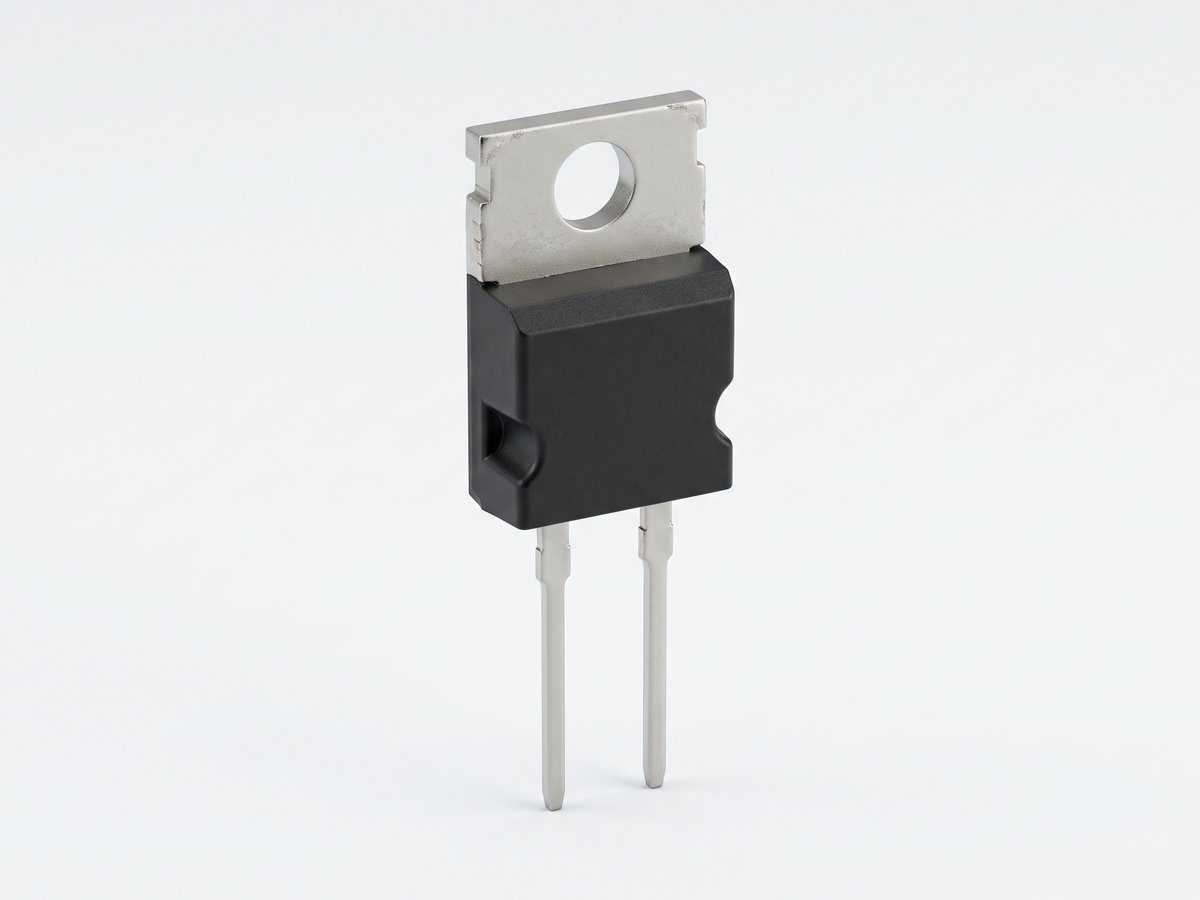
TO-220-2 is the two-lead version of the TO-220 through-hole package, here holding a single SiC Schottky diode with anode and cathode leads and a metal mounting tab.
A SiC Schottky diode is a majority-carrier device, so there is no stored charge to recover at turn-off; the small reverse current that remains charges the junction capacitance and does not change with temperature.
IRONHAWK lists 650 V parts at 6, 10 and 20 A and 1200 V parts at 5 and 10 A.
When to use
- Boost diode in continuous-conduction-mode PFC, where a silicon diode's reverse recovery adds loss in both the diode and the MOSFET.
- Freewheeling and clamp diodes in hard-switched converters.
- Output rectifiers in high-voltage DC/DC converters.
- Lower-current positions where a TO-247 would be larger than needed.
Parts
| Part number | Configuration | VRRM (V) | IF (A) | Datasheet | Quote |
|---|---|---|---|---|---|
| IHSS06A006K2 | Single | 650 | 6 | Datasheet | Get quote |
| IHSS06A010K2 | Single | 650 | 10 | Datasheet | Get quote |
| IHSS06A020K2 | Single | 650 | 20 | Datasheet | Get quote |
| IHSS12A005K2 | Single | 1200 | 5 | Datasheet | Get quote |
| IHSS12A010K2 | Single | 1200 | 10 | Datasheet | Get quote |
Details
Configurations
- Single (5)
Common features
- Zero reverse-recovery current
- Switching behaviour independent of temperature
- Positive temperature coefficient of VF for easy paralleling
Design notes
- In discontinuous or critical-conduction PFC the diode current reaches zero before the switch turns on, so recovery loss is already small and a silicon diode with lower forward voltage at high current may be the better choice.
- Inrush at start-up is a weak point for Schottky diodes. Check IFSM in the datasheet and add a bypass diode from the rectified input to the output capacitor where inrush is large.
- The tab is part of the circuit. Use an insulator and bushing unless the heatsink sits at the same potential, and tighten screw or clip to a controlled torque.
- Forward voltage rises with temperature at high current, which helps paralleled diodes share current.
FAQ
650 V or 1200 V?
Choose the class whose repetitive reverse voltage rating covers the highest voltage the diode blocks, including ringing, with margin. Compare forward voltage at your current between the classes before choosing the higher one.
How do I read the current rating?
IF is a DC rating under the conditions stated in the datasheet. In a PFC the diode carries pulsed current, so check average and peak current and the junction temperature you will reach against the datasheet curves.
Where is Qrr in the datasheet?
SiC Schottky datasheets give QC, the capacitive charge, instead. It adds turn-on loss in the switch as Qrr does, but it does not grow with temperature.
Can I parallel two diodes?
Yes. Mount them on the same heatsink so they run at similar temperatures, and keep their connections symmetrical.